
Solo 401(k) vs. SEP IRA: trade-offs for fractional executives
Solo 401(k) vs. SEP IRA: compare 2026 contribution limits, Roth options, deadlines, and paperwork for fractional executives with no employees.
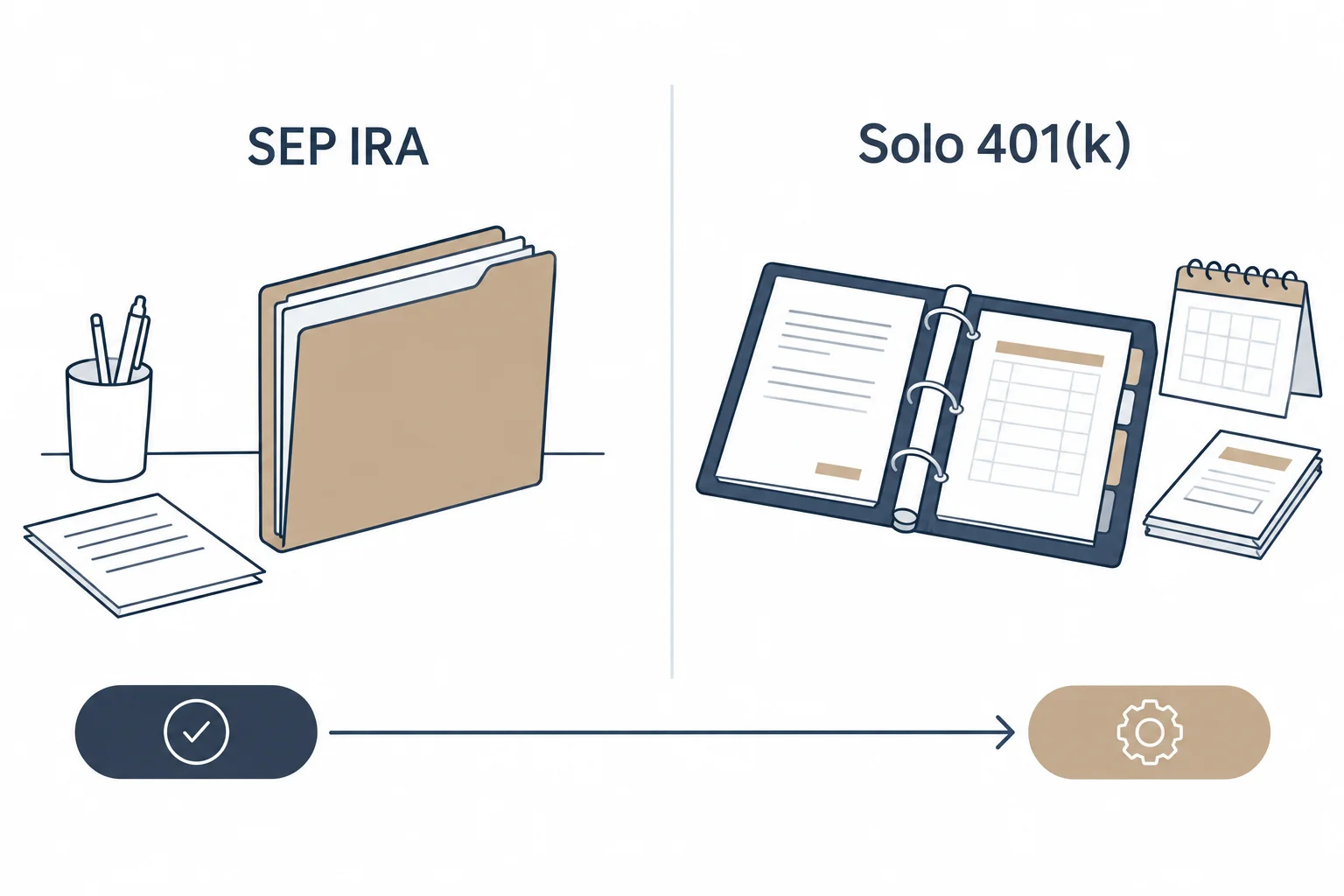
Start with the trade-off: simpler administration or more ways to contribute
If you’re a fractional CFO, COO, or CMO running a business without employees, choosing a retirement plan can feel like one more decision competing for your attention. Your income may vary, and there’s no employer plan waiting for you to join. When I help clients think this through, we look beyond the headline contribution limit. We start with how the business is structured, how much income it generates, what other retirement plans you use, your tax picture, and how much administration you’re willing to take on. That broader view helps us choose a plan that fits your life, not just a maximum on paper.
For example, I recently worked with a fractional COO who consulted for several startups. Her income fluctuated each year, and she wanted to save aggressively when cash flow allowed. After reviewing both the Solo 401(k) and SEP IRA, she decided on the Solo 401(k) because it let her make larger contributions in good years by taking advantage of employee deferrals. While the plan required more paperwork, she decided the flexibility was worth it, especially since she had no employees. This process helped her match her plan choice to her actual income and administrative bandwidth.
A SEP IRA, short for Simplified Employee Pension Individual Retirement Arrangement, generally offers simpler administration. Under the IRS rules for 2026, it takes employer contributions and generally requires no annual plan filing from the employer. Its contribution structure limits you to the employer role.
A Solo 401(k) is a one-participant 401(k). Under the IRS rules for 2026, the owner can contribute as both employee and employer. Those separate roles can change contribution capacity at a given income, but the plan carries additional administration and potential annual reporting.
So which plan is the better fit? There isn’t one right answer for every business owner. In my planning conversations, I weigh the appeal of simpler administration against the value of employee deferrals, then consider tax treatment, other workplace-plan participation, and whether the savings goal still feels manageable in a lean year. First, let’s look at how much the employee option can add.
How do the contribution roles differ?
For tax year 2026, a SEP IRA receives contributions from the business as employer. It has no separate employee salary-deferral component.
A Solo 401(k) also accepts employer contributions, and the owner may make an elective deferral—compensation directed into the plan in the employee role. For 2026, both contributions remain subject to earned-income and annual limits. This employee option can increase capacity, but it does not guarantee a larger total in every situation; the example below shows when it does.
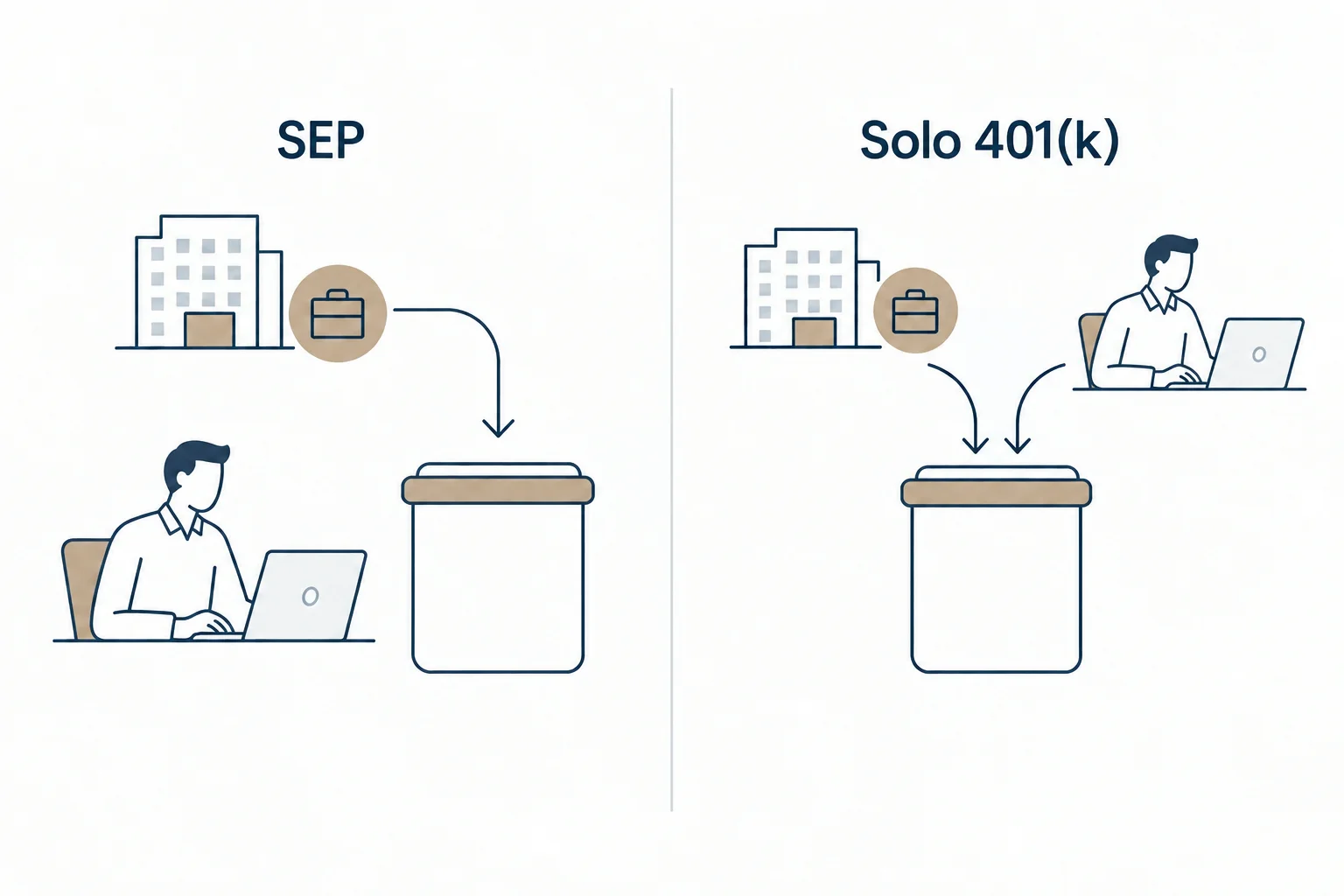
For example, consider a fractional CFO operating as a sole proprietor in tax year 2026. The employer-contribution calculation uses self-employment earnings adjusted for the deductible portion of self-employment tax and the owner’s contribution. With a SEP, that employer calculation determines contribution capacity; with a Solo 401(k), the owner may also have an employee-deferral option. A planner would first verify the business structure, earned income, and participation in other employer plans before estimating the allowable amount. The same sole-proprietor illustration will carry through the comparisons below.
How much more could the employee option allow?
For tax year 2026, these IRS annual limits and self-employed contribution rules apply before catch-up contributions:
| Contribution limit for 2026 | SEP IRA | Solo 401(k) |
|---|---|---|
| Employee deferral | None | Lesser of $24,500 or 100% of earned income |
| Employer contribution | Up to 25% of compensation, with a reduced rate for sole proprietors | Up to 25% of compensation, with a reduced rate for sole proprietors |
| Annual total | Lesser of $72,000 or the employer formula | Lesser of $72,000 or 100% of compensation |
| Compensation considered | Up to $360,000 | Up to $360,000 |
For the fractional CFO example, assume tax-year 2026 adjusted earnings of $100,000 after required self-employment adjustments but before the owner’s retirement contribution. This is not gross business revenue, the total client receipts before business expenses and adjustments. Under the IRS sole-proprietor worksheet, a 25% plan rate becomes a 20% effective rate.
Using that rule and the 2026 employee-deferral limit:
SEP IRA: $100,000 × 20% = $20,000 employer contribution.
Solo 401(k): $20,000 employer contribution + $24,500 employee deferral = $44,500 total.
In this example, the employee deferral adds $24,500 of capacity, assuming the owner is eligible to make the full deferral and has not used the limit through another plan. At higher earnings, the shared $72,000 annual ceiling for 2026 can narrow or eliminate the difference. A planner would model the allowable contribution against actual earned income, other plan deferrals, and cash flow before treating the maximum as a target. The advantage depends on the owner’s facts—not just the plan label.
Contributions can affect your taxes, and how they do depends on your situation, so talk to a tax professional.
People age 50 and older may be able to make additional catch-up contributions to a Solo 401(k). A SEP IRA has no employee catch-up, and catch-up rules have changed recently, so check the current IRS rules.
The calculation works differently for owners paid W-2 wages through an S corporation.
Can either plan offer Roth contributions? It depends on the plan terms.
For tax year 2026, Roth is a contribution tax treatment involving current taxation and qualified tax-free distributions. It does not identify a separate investment.
A Solo 401(k) can offer designated Roth employee deferrals, which share the employee-deferral limit with pre-tax contributions. Separately, plan terms may permit Roth employer contributions. These are distinct options.
For 2026, SECURE 2.0 Section 601 permits optional Roth SEP contributions when offered and affirmatively elected. They remain employer contributions and count as part of the participant’s gross income.
For the fractional CFO in the earlier example, Roth treatment could therefore apply to employee deferrals in a Solo 401(k), separately authorized employer contributions, or employer contributions to a Roth SEP.
Under the 2026 designated Roth rules, Solo 401(k) distributions, including earnings, generally become tax-free after five taxable years and age 59½, disability, or death. Roth SEP distributions also require applicable holding-period and qualifying-event conditions for tax-free treatment.
How do you choose a provider that supports the features you want? Start by identifying the exact plan design—not just “Roth.” For a SEP, ask whether the provider currently supports Roth SEP contributions, how they are reported for tax purposes, and whether its documents and account process accommodate them. For a Solo 401(k), confirm whether designated Roth employee deferrals are available and whether Roth employer contributions are permitted; these are separate features.
To help you get started, several well-known providers currently offer both Roth SEP IRAs and Solo 401(k)s with Roth features. Examples include Fidelity, Vanguard, Charles Schwab, and E-Trade. Availability and features, including Roth options, can change, so review each provider’s latest offerings and ask about specifics before deciding.
Then check investment choices, fees, account minimums, setup support, contribution procedures, and distribution or rollover rules. Provider menus change, so get confirmation in writing and make sure the plan document authorizes the feature.
When must you set up the plan, elect contributions, and deposit them?
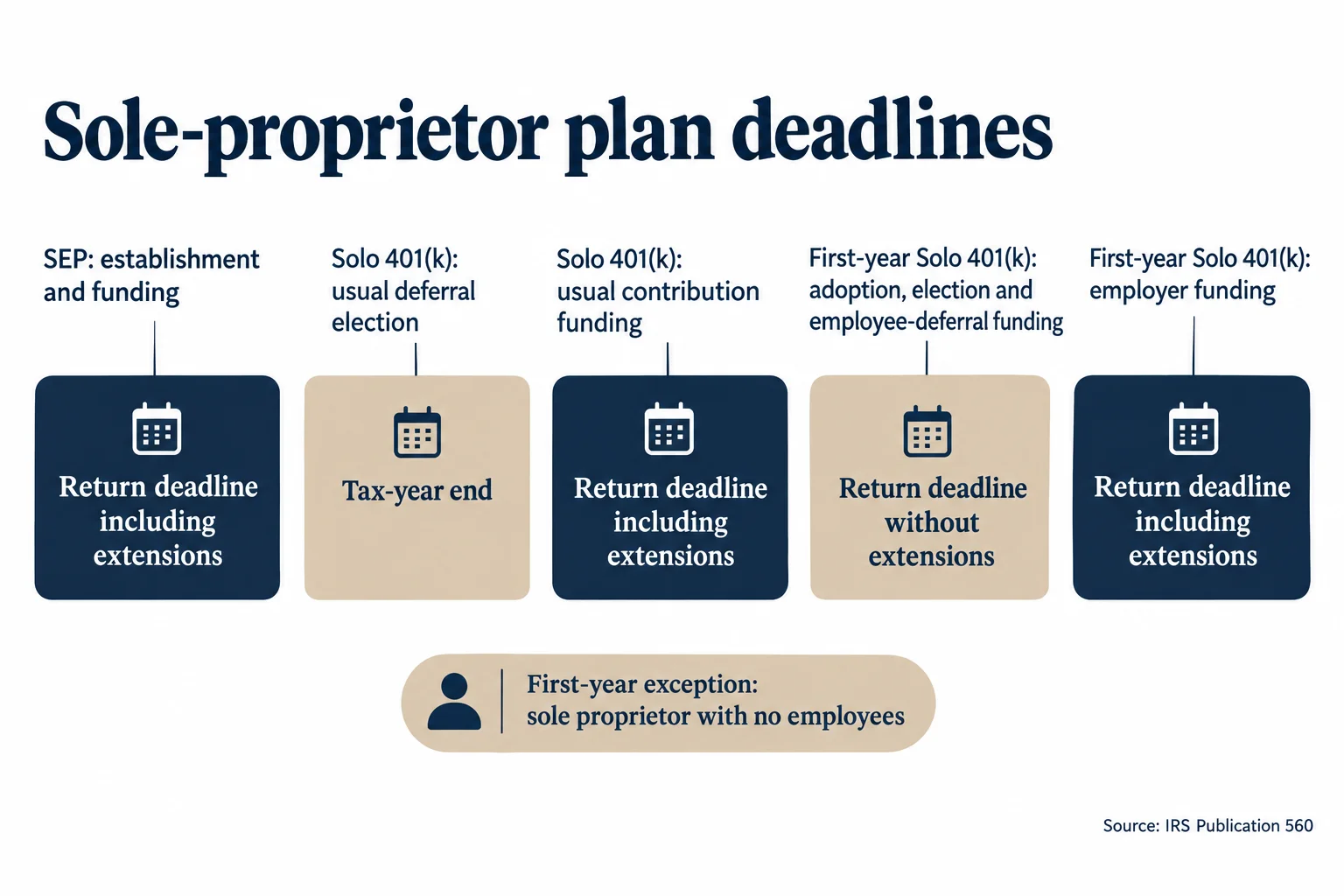
For the fractional CFO continuing as a sole proprietor, “establish” means formally adopting the plan; “fund” means depositing contributions. Signing plan documents and moving money are separate steps.
For tax year 2026, the deadlines differ:
| Step | SEP IRA | Solo 401(k), sole proprietor only |
|---|---|---|
| Establish | Return deadline, including extensions | Return deadline, including extensions, for employer contributions; employee deferrals have separate rules below |
| Elect employee deferrals | None; contributions are employer-only | Generally by tax-year end |
| Fund | Return deadline, including extensions | Generally the return deadline, including extensions, subject to the first-year exception below |
What if you decide on a Solo 401(k) after 2026 ends? For a new plan covering only the sole proprietor, a first-year exception allows adoption and a deferral election after year-end. Both adoption and election, along with employee-deferral funding, must meet the return deadline without extensions. Employer contributions can still follow the extended deadline. This exception is specific to the stated sole-proprietor scenario, so confirm the rules for your business structure.
What does setup involve, and how long does it take? Both plans require choosing a provider and completing account and plan paperwork; a SEP can generally be established with Form 5305-SEP or another permitted agreement, while a Solo 401(k) requires a written plan document. A typical straightforward application may take days to a few weeks, but provider review, identity checks, business paperwork, and plan design can affect timing. Treat that as a planning estimate, not a deadline guarantee. Start early—especially if you want employee deferrals—because plan adoption and election deadlines can be strict. Ask the provider for its current processing timeline.
Here’s a brief outline of the main setup steps for each plan:
For a SEP IRA:
- Fill out and retain Form 5305-SEP or a similar plan agreement.
- Provide eligible employees, if any, with information about the plan (for a business with no employees, this step is generally straightforward).
- Open and fund a SEP IRA account at a financial institution.
For a Solo 401(k):
- Obtain or draft a written Solo 401(k) plan document from a provider.
- Apply for an Employer Identification Number (EIN) if you do not already have one.
- Open a Solo 401(k) account at a financial institution.
- Elect employee deferrals before year-end if you wish to make them for the first year.
- Fund the account according to IRS deadlines.
Once the provider confirms the account and plan documents are complete, keep copies of the signed agreement, account-opening records, and any deferral election. Build in processing time rather than waiting until a tax deadline; opening the account and meeting the plan’s legal deadlines are related but separate tasks.
What ongoing reporting should you expect?
A SEP is administratively simpler and generally requires no annual employer Form 5500 filing. For 2026, employers still retain contribution records and provide participant information. The financial institution reports contributions on Form 5498, while the payer handles applicable Form 1099-R distribution reporting.
A Solo 401(k) adds ongoing plan administration, including tracking contributions and year-end assets. Form 5500-EZ is an annual retirement-plan information return. Under the 2025 filing instructions, the filing exemption generally applies when combined assets of all the employer’s one-participant plans “do not exceed $250,000” at year-end. Exactly $250,000 remains within that exemption. Above that amount, each plan requires a return.
Those instructions also require a final-plan-year return regardless of asset value. For the 2025 plan year, the general deadline is the last day of the seventh calendar month after year-end, normally July 31, 2026, for a calendar-year plan.
Switching plans, costs, and common compliance pitfalls
Can you switch from a SEP IRA to a Solo 401(k), or vice versa? Often, you can adopt a different plan for a future year, but that is not always a simple account conversion. A SEP IRA balance may be eligible for rollover to a 401(k) if the receiving plan accepts it and the distribution rules are met; confirm the treatment before moving money. A Solo 401(k) balance can generally be rolled into a SEP IRA, which accepts rollovers from qualified plans; confirm the receiving provider accepts it before moving money. You may be able to keep the old plan while starting a new one, but coordinate contributions, deadlines, fees, and any eligible-employee obligations with your providers and tax professional. Don’t close or transfer an account until you understand the tax and plan-document consequences.
Here is a step-by-step outline for switching plans:
- Review your current plan: Confirm the type of account you have, the plan document terms, and if there are any open contributions, pending transactions, or compliance requirements.
- Choose and set up the new plan: Select a provider and complete the necessary paperwork for your new plan (SEP IRA or Solo 401(k)), including adopting plan documents and opening accounts.
- Check rollover eligibility: Confirm that balances from your old plan are eligible to roll over to the new plan, and verify that the new provider will accept the rollover. Ensure you meet all IRS rules for rollovers and follow the correct process for each account type.
- Coordinate contributions: Track and separate current-year contributions. Make sure you do not exceed IRS annual limits by combining old and new plan contributions, and clarify how contributions should be allocated for the tax year.
- Complete the rollover: Request the distribution or rollover from your old account and follow the provider’s steps for timely transfer, ensuring the process is direct (trustee-to-trustee) if possible.
- Update records: Keep documentation of the rollover, plan setup, contribution records, and any correspondence with providers.
- Notify your tax professional: Share details of the transition so your filings reflect all contributions, rollovers, and potential reporting obligations.
- Close or adjust the old account: Once all balances have transferred and reporting is settled, consider whether to formally close or maintain the account, based on your needs and advice from your provider.
Timing tip: Switching plans can take several weeks. Start early in the tax year if you intend to make both contributions and rollovers, as deadlines for establishing, funding, and electing deferrals are strict. Consult both providers and a professional for current rules before acting.
What do these plans typically cost? A SEP IRA often has no separate plan-administration fee, but providers may charge account, investment, transaction, or advisory fees. Typical SEP IRA account fees for individual investors can range from $0 to $50 annually, depending on the provider. Most major brokers do not charge setup fees for a SEP IRA, but investment expenses still apply.
A Solo 401(k) may add a setup or annual document fee. Setup fees with major providers usually range from $0 to $300, while annual administrative fees can range from $0 to $150 for straightforward Solo 401(k) plans. For document updates, amendments, or advanced features (such as Roth or loan options), some providers may charge fees from $50 to $250 or more per year. Some specialty administrators, especially those offering custom plans or checkbook control, may charge $400 to $1,000 up front and similar amounts annually, depending on the level of service. Investment and account fees may apply too.
No single standard price exists, and no-fee offers may trade off features or investment choices. Compare the full schedule of fees in writing—including recurring costs and costs to amend, terminate, or transfer the plan—rather than comparing setup fees alone.
What compliance mistakes should you watch for?
In my experience, the most avoidable problems come from treating a one-participant plan as paperwork-free. Common pitfalls include miscalculating self-employed compensation, exceeding the shared employee-deferral limit across plans, missing a deferral election or deposit deadline, overlooking an eligible employee after hiring, failing to file Form 5500-EZ when required, and assuming a provider offers a feature that the signed plan document does not permit. Keep contribution records, calendar deadlines, review the plan when your business or workforce changes, and ask your provider or tax professional when the rules are unclear. These checks help prevent small oversights from becoming costly corrections.
To make compliance easier and reduce risk, consider using digital tools dedicated to retirement-plan administration and deadline tracking. Apps like Gusto or integrated platforms from major providers such as Fidelity or Vanguard can help automate reminders for critical filing and funding deadlines. Task management apps such as Todoist or Asana can be customized to track annual plan reviews, document retention, and IRS filing dates. For storing digital records and secure documents, cloud storage services like Dropbox or Google Drive, with organized folders, can help keep key paperwork easily accessible. Many brokerage platforms also now offer dashboard alerts for plan administration tasks. Choosing a tool suited to your workflow can help fractional executives streamline ongoing compliance and keep important requirements from slipping through the cracks.
For 2026, the Solo 401(k)’s employee and employer contribution routes offer flexibility, with added administration. The SEP IRA’s simpler administration comes with an employer-only contribution structure. Both accounts have their place.
Roth availability belongs alongside contribution capacity in the decision. So do the setup, election, and funding deadlines already discussed. A plan’s features need to fit both your contribution needs and the work required to maintain it.
After comparing features, setup time, transition rules, fees, and compliance responsibilities, return to the central question: which plan can you use consistently? A SEP IRA may fit if employer-only contributions meet your goal and you value simpler administration. A Solo 401(k) may fit if employee deferrals matter enough to justify the added plan upkeep. Either way, confirm the provider’s current terms and keep a reliable calendar and recordkeeping process.
Before acting, coordinate the decision with a qualified financial planner, tax professional, or retirement-plan specialist. Ask them to verify your business structure and compensation calculation, check interactions with other plans and eligible employees, compare provider costs and plan terms, and confirm current-year deadlines and tax treatment. The right choice fits your broader financial plan and can be administered consistently—not simply the option with the highest advertised limit.
This is a demonstration by FlowOps360. Demo Wealth Partners is fictional. Nothing here is investment, tax, or legal advice.
Sources
- Simplified Employee Pension Plan Sep — IRS
- One Participant 401k Plans | Internal Revenue Service — Internal Revenue Service
- Self-employed individuals: calculating your own retirement plan contribution and deduction — Internal Revenue Service
- Retirement topics - 401(k) and profit-sharing plan contribution limits — Internal Revenue Service
- Publication 560 (2025), Retirement Plans for Small Business — IRS
- Retirement Topics: Catch-Up Contributions — IRS
- Roth account in your retirement plan — IRS
- Retirement topics - Contributions — Internal Revenue Service
- Internal Revenue Bulletin: 2024-02 — Internal Revenue Service
- Retirement plans FAQs on designated Roth accounts | Internal Revenue Service — Internal Revenue Service
- Retirement plans: FAQs regarding SEPs — IRS
- Form 5305-SEP, Simplified Employee Pension—Individual Retirement Accounts Contribution Agreement — Internal Revenue Service
- SEP Plan Overview — Internal Revenue Service
- Reporting IRA and retirement plan transactions | Internal Revenue Service — Internal Revenue Service
- 2025 Instructions for Form 5500-EZ - IRS — IRS
This article is general education, not individualized investment, tax or legal advice. Talk to a professional about your situation.